Showing posts with label WS14. Show all posts

Thursday, January 15, 2015

vocabulary #2


Hey everyone!


It's time for another round of vocabulary learning strategies! This time I am going to tell you how I intend to study for the second progress check in English. For this exam we have to study about 700 words (!!!!!!), including definition, collocations and the right pronunciation. Yes, you’ve read right.  


First of all we (a couple of other students and me) formed a group to make a glossary (which is a lot more helpful). Then we split up the words, so everyone had to work on a little more than 100 words. The columns of the glossary included the definition of the word, the German translation (which, especially I, definitely need), example sentences, word family (words which have the same roots) and collocations. 

There are a number of websites I used when working on the glossary, but the main website was vocabulary.com. It just provides you with the simplest definition and dozens of up-to-date example sentences of very reliable sources such as the New York Times. The only information you do not get at vocabulary.com is a German translation, which is, by the way, a negative aspect of this website. Besides using vocabulary.com, I often work with the Oxford Advanced Learner’s Dictionary. It also shows you good and easy understandable example sentences. 
For finding German translations I usually go with pons.com. It’s a website which is uncomplicated to navigate through and gives you a great German translation (not only for English). What’s more, sometimes you can even look up some unfamiliar phrases. 

As soon as we had finished the glossary (which took us a looot of time, despite being 5 people working on that), I started to work my way through this forest of words. Pretty soon I found out that this is going to be a very very very challenging exam!!! Fingers crossed I will pass it!


Saturday, January 3, 2015

pronunciation post #2


Hello everybody! I am back with pronunciation blog post #2.
This time, I went a bit more into details when practicing my pronunciation. I watched a couple of videos from different youtube channels, such as videos from Amy Walker and Rachel's English (although in my opinion, Rachel's videos are a bit too theoretical and I am not sure if completely analyzing every sentence or word I am saying works for me) and I read through various websites regarding any pronunciation tips and tricks.

First of all I need to tell you that I am aiming for an AMERICAN ACCENT. Although I think the British accent sounds very cute too, I would prefer myself having an American accent.

Well, the first thing I came across on every single page I looked at was the "schwa" sound (pronounced like "uh"). It is said that this sound is the most common sound in the English language and a main characteristic of the American accent. I found a very helpful intruction on how to make the schwa sound:
"Put your hand on your diaphragm and push until a grunt escapes. Don't move your jaw, tongue or lips; just allow the sound to flow past your vocal cords. It should sound like uh, not ah."

A good word to practice this sound is: photography ("phuh-tah-gruh-fee"). Other words where the schwa sound occurs are: love, was, today (today for example was a word I totally pronounced wrong all the time - I didn't say tAday but tUday), forever, money, because, wonder, etc. (schwa sound in bold letters).

Another sound which I have to work on is the "th" sound. Although I know how to pronounce both of the th sounds, I am always a bit too sloppy and imprecise when I am speaking or reading words with the th sounds.
Well, there is the voiced th sound and the unvoiced th sound. When I was looking them up on the internet I came across this definition:
"In general, the voiced th sound occurs in far fewer words than the unvoiced th. However, the voiced th sound is more common in function words (such as articles, pronouns, and demonstratives). For example, the function words the, that, them, these, they, their (and more), are pronounced with a voiced th".

If you do not know the difference between voiced and unvoiced, just remember: if you make a voiced sound you can feel vibrations in your throat and on your lips.

To make the voiced th sound just put your tongue between your theeth and blow/press the air out. Words which contain the voiced th are: thought, thanks, math, with, therapy, mouth, etc.
To master your th pronunciation try to say these sentences:
"Think about this thing, that thing and those things".
Think and thing are pronounced with an unvoiced th sound whereas this, that and those are pronounced with a voiced th.

Or: "I will eat anything healthy with my teeth".

I realized that I find it very difficult to say "these things" in one sentence. So I will have to work on that!

More sounds that are hard to distinguish are the "ch" and the "sh" as well as the "s" and the "z".

To practice the "ch" and "sh" sounds try to say this sentence:
"Those sheep are cheap". (and hey, there is even a th sound in this sentence ;) )

Regarding the "z" and the "s" you need to know that the "z" is voiced and the "s" is unvoiced.

Try to say: sip - zip, bus - buzz
"Because it's sunny and he's fair skinned he has to wear sunscreen".

Well, after practicing the right pronunciation, it's important to know another main characteristic of the English language: melody or intonation. This means, if someone wants to acquire an English accent it is important to say everything with a nice little melody.

So let's work on our English accent! ;)


Friday, January 2, 2015

It's all about pronunciation #1!

This new blog post is about pronunciation. Well, I guess everyone who speaks foreign languages always aims on speaking them fluently and with an accent that sounds like the one of a native speaker. But we all know too, this isn’t very easy. Every “nation” has their own accents when speaking in a foreign language, i.e. when Italians or French speak English. Also Germans have a very, let’s say “unique”accent when speaking English. This always is very funny if you listen to them, but no one actually wants to sound like this too. So to lose this accent, I am currently working on my pronunciation. 

Since I started learning foreign languages, I love to read a text out loud whenever I can. This means, if I am studying I usually speak aloud. I not only enjoy this, it also helps me to improve my pronunciation. But this is not enough anymore. We definitely have to get  to another level when it comes to practicing pronunciation. Even though I hate listening to my own voice (even in German! – I just think I sound terrible - do I really have such a deep voice?!?!  – but I guess most of us do not like listening to their own voice) I started recording myself. There is a pretty good website on the internet (vocaroo.com) where you can record yourself and save it as a MP3 file. Also the quality of the sound is good!


I started with one of the exercises provided by our English teacher. On this website, they suggest reading a story (without looking at it before) and retelling the story afterwards. Well, it has come to my attention that my pronunciation is better when I am reading something than when I am talking freely. But this is actually not something that surprises me. It’s just easier to pronounce a word when you actually see it.
I also started to read aloud when reading a book (but I have to admit it is harder for me to follow the content of the book when reading aloud, as I then focus on pronouncing the word rather than really understanding what I am reading). Still, I think reading aloud any English texts that come across you will help to improve your pronunciation. 

When I am watching an English movie or simply an interview in English, I use to listen to the pronunciation of the actors. As I love how the English language sounds, I often find myself to go into raptures about a certain person speaking English if they have a special accent or dialect or something. I also like to figure out which accent they are speaking as I am interested in that too. 

There is still a lot of work to do regarding my pronunciation – but I will stay tuned!


Thursday, December 4, 2014

summary comparison

Hey everyone! My new blog post is about the two summaries we had to write for English class.

1st summary


The first summary is about a video we watched in English class. The video is about the financial crisis of 2008. This is a before-and-after blogpost based on the summary I wrote about the video. The second summary is the corrected version. 

1. first version:

The Crisis of Credit Visualised:
The video explains the world-wide financial crisis and how it affected the economy and therefore, the whole population. There are two important groups of people, the homeowners and the investors. Homeowners apply for mortgages given by the investors. The investors get their money from large institutions such as, sovereign, pension and mutual funds. To get more money they would buy treasury bills from the US Federal Reserve. As a result of economic crises and terrorist attacks, the Federal Reserve lowered interest rates to keep the economy working. The following cheap credits facilitated borrowing money resulting in banks going crazy with leverage. Banks started to connect investors to homeowners through mortgages. Due to investors craving for more money, they began taking risks by giving mortgages to homeowners that were less likely able to pay them off, called subprime mortgages. Subsequently, several homeowners default on their mortgages. The bankers’ monthly payments turned into houses. More and more houses were on the market creating more supply than demand.  This resulted in houses losing their value and even homeowners who were considered prime mortgages left. The brokers could not sell their houses anymore as everyone was bankrupt. In the end the financial system froze.


2. version (corrected):


The video “The Crisis of Credit Visualised” from the website crisisofcredit.com explains the 2008 world-wide financial crisis and how it affected the economy and population. There are two groups of people that were brought together by the credit crisis, the homeowners and the investors. Homeowners apply for mortgages given indirectly by the investors. The investors are large institutions such as, sovereign, pension and mutual funds. To get more money they used to buy treasury bills from the US Federal Reserve. As a result of economic crises and terrorist attacks, the Federal Reserve lowered interest rates to keep the economy working. The following cheap credit facilitated borrowing money which made rendering treasury bills unattractive and resulted in banks wanting further money. 
Banks started to connect investors to homeowners through mortgages. Due to investors urging for more money, they began taking risks by giving mortgages to homeowners that were less likely to pay them off, called subprime mortgages. Subsequently, several homeowners defaulted on their mortgages. The bankers’ monthly payments turned into houses. Ever more houses were on the market creating more supply than demand.  This resulted in houses losing their value and even homeowners who were considered prime mortgages left as they weren’t willing to pay more money than necessary. The brokers could not sell their houses anymore as everyone was bankrupt. In the end the financial system froze.

2nd summary:

1. version:

Great Profits During The War:


The article discusses the question whether innovators should profit from warfare or act from pure patriotism instead.
Before World War One, which is also called the Great War, Britain had no military-industrial complex to facilitate warfare. Scientists would risk their lives because of sole patriotism. Not only patriotism was a reason for industrial activity in wartime, also financial rewards that were awarded after the war ended in November 1918. When Britain entered the war on the 4th of August 1914, the Marconi Company offered wireless operators and training. They helped to facilitate the armed services’ use of wireless communications without demanding payment. Telecommunications had been very important during the war. The Fullerphone, invented in 1916, was of great importance as well. Despite this, the inventor was less rewarded for it than he had hoped but later was able to reach the rank of a major-general. As Marconi played a major role in supporting the British government, they also wanted a large refund for their industrial contributions. This caused a post-war dispute between the British government and the company. Although the exact amount of the refund is not officially known, the company was able to become a telecommunications giant now called “Cable and Wireless”.
So did those innovators just want to take advantage out of warfare, or did they really donate their all to the cause?


2. version (corrected):


The article in “The Guardian” from the 28th of October 2013 by Elizabeth Burton and Graeme Gooday discusses the question whether innovators should profit from warfare or act from pure patriotism instead.

Before World War One, Britain had no military-industrial complex to facilitate warfare. Scientists would risk their lives for sole patriotism. Patriotism was not the only reason for industrial activity, but also financial rewards that were awarded after the end of the war. When Britain entered the war in 1914, the Marconi Company offered wireless operators and training. They helped to facilitate the armed services’ use of wireless communications without demanding payment. Due to the fact that France and Britain were scientifically ahead of Britain, it established the Department of Industrial Research in 1915. Telecommunications had been very important during the war as it helped to intercept the enemy’s communication. The Fullerphone for example, invented in 1916, was of great importance. Despite this, the inventor was less rewarded for it than he had hoped but later was able to reach the rank of a major-general. As Marconi played a major role in supporting the British government, they also wanted a large refund for their industrial contributions. This caused a post-war dispute between the British government and the company. Although the exact amount of the refund is not officially known, the company was able to become a telecommunications giant now called “Cable and Wireless”.
So did those innovators just want to take advantage out of warfare, or did they really donate their all to the cause?


What I need to work on:

In my first version of the 1st summary I used too many informal words. In order to improve my summary writing skills I need to work on my register. 

To improve my  first summary, I had to take another look at the video itself as my first text included some wrong information based on a misunderstanding of the video. 

What's more, in the first as well as in the second summary I forgot to mention the source of the text as well as the title and the author.

It will be necessary for me to read more newspapers as they contain articles that will help to improve my academic vocabulary and register. 


Sunday, October 26, 2014

How are YOU going to improve your treasury of words?! vocabulary #1

Hey guys!
I know it’s been awhile since my last post but I am back with a
hopefully helpful  topic. 

As year two is well underway, it's high time to intensify on efforts to boost our vocabulary. I’ve realized already that this year will require a more concentrated effort and it is absolutely necessary to keep on improving our treasury of words. Well, I have given some thought to the various strategies I use to boost my vocabulary and would like to share some of them with you.

I usually always have a vocabulary book with me where I can write down all the words and phrases I am unfamiliar with which come up in an English class or in one of the articles I read during the day.  I started using this method last year when studying Spanish. It was unquestionably necessary to write down every Spanish word I heard as my vocabulary was as tiny as a grain of rice. Haha! 
So write down all the unfamiliar words that may come across you during the day and read through them again before you go to bed. This helps memorizing it better. 


What I find helps me remember new words or phrases is creating funny or even ridiculous sentences containing those phrases or words. This way you will never forget them again and studying vocabs may even become an entertaining exercise. At least it might.
Some people find it more helpful to construct example sentences that are true or relevant to your life as this creates a personal connection to the new word. Your choice!

I bet every one of you is listening to at least one English song per day, right? Well, you might have realized (like I did!) that memorizing lyrics is so much easier than memorizing stuff you need to know for uni/school. Annoying! But why not combine music (which is fun!) with studying (which is not so much fun)? All the more when you study foreign languages. So why don’t just look up the lyrics of your favorite song and see if there is any vocabulary you are unfamiliar with (and there are for sure a couple of words as it is sometimes hard to understand the sinders). If so, write it down! Then, As I  listen to this song many times (as I like it), the words I looked up usually get etched onto my brain. Try it out!

Another trick I have is writing vocabulary on post-its and putting them in plain view everywhere around my flat. This forces me to look at them nearly every day and it doesn`t take long until I have memorized whatever is on them forever. 

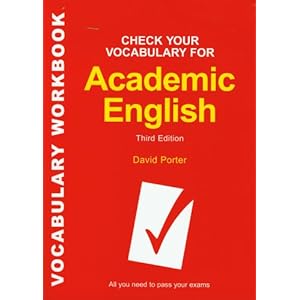
As every language learner should know by now, there are plenty of books and tools on the internet to boost your vocabulary. One book we are using at university is the David Porter book for Academic English. After doing a few exercises i could tell it is going to be helpful! Many of the words in this book were new to me so I had to look them up in an online dictionary before doing the exercises. Each unit has five exercises. The ones I find most challenging are the b-exercises where you habe to decide which one of the two words given is more suitable. The words given have very similar meanings that's why you need to know the exact definition of each one. The very last exercise (the f-exercise) of each unit is difficult too as you need to know certain collocations. The only thing I would criticize is that they do not provide a German translation of the words. I personally always need German translation in order to completely understand a word. 


I would also advise you to sign up at the website vocabulary.com. There you can find plenty of vocab lists created by teachers and other users, plus you can create your own lists which is very helpful too. Additionally, there are quizzes for every vocabulary list which will help you to really get to know a certain word.


I am not totally convinced yet by the corpora websites. Many of them are just very confusing and difficult to navigate through. What's more, the long example sentences provided (i.e. at just-the-word.com) are sometimes very difficult to understand and often the website does not even provide full sentences.


One website I use very often, however, is thesaurus.com. I love this one and can really recommend it as it shows you plenty of synonyms for every word. This definately helps to broaden your treasury of words! Of course I would recommend using monolingual dictionaries such as Oxford Advanced Learner's Dictionary (OALD) which provides fantastic explanations of each and every word as well as useful example sentences. 

Anyway, extending your vocabulary will always be a strenous process. It's time-consuming and a lof of hard work but with the right techniques you will soon see progress! :)

Have fun trying out the very different methods of boosting your treasury of words!


(This is already the corrected version!)